Stride 4.4 release notes
Stride 4.4 is one of the largest updates the engine has received in years, with roughly 2800 commits since the previous version!
The main focus of this release was on modernization and reach, which includes much more stable Vulkan and Direct3D 12 backends, support for non-Windows platforms no longer being experimental and an overhaul of the shader compiler.
This update also includes many exciting new features, such as a CLI tool, ability to replace read-only assets and much more.
Highlights
Here are a few of the stand-out changes:
📱 Platform support
So far, Stride has mostly been a Windows-first engine. Other platforms were supported, but creating and running games on them would often lead to many problems. This update changes that.
All platforms have been brought back into shape and the test suite for them has been expanded to make sure they won't fall behind again. Additionally, with changes to the asset compiler, building projects on Linux and macOS now works the same as it does on Windows.
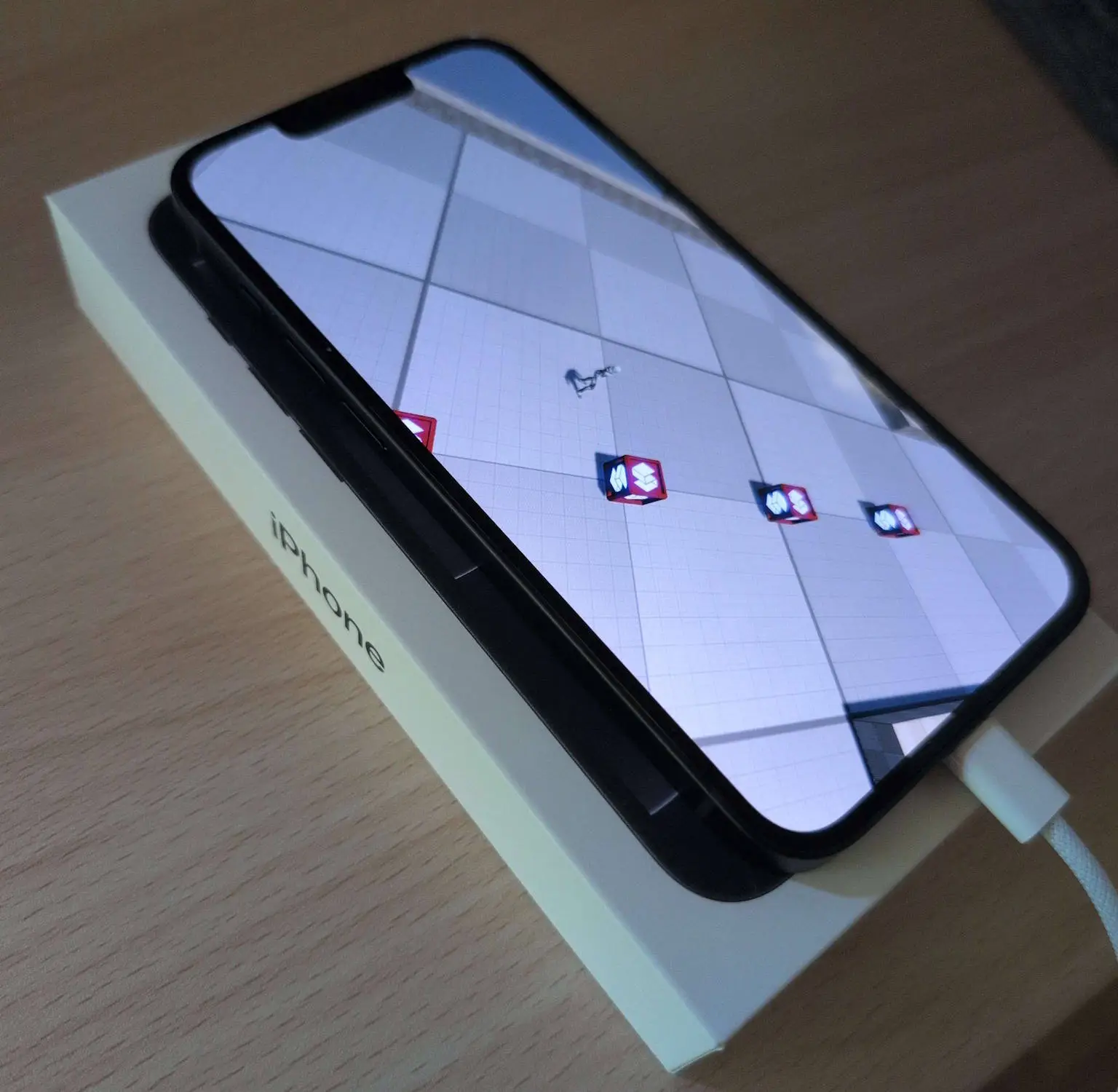
For Linux users: this release removed some legacy code which now makes it possible to use Game Studio on Linux via Proton/Wine. The experience isn't as solid as on the native Windows version, but it's still a big step forward for Linux development. If you'd like to try it out, we have created a guide that's available in the documentation.
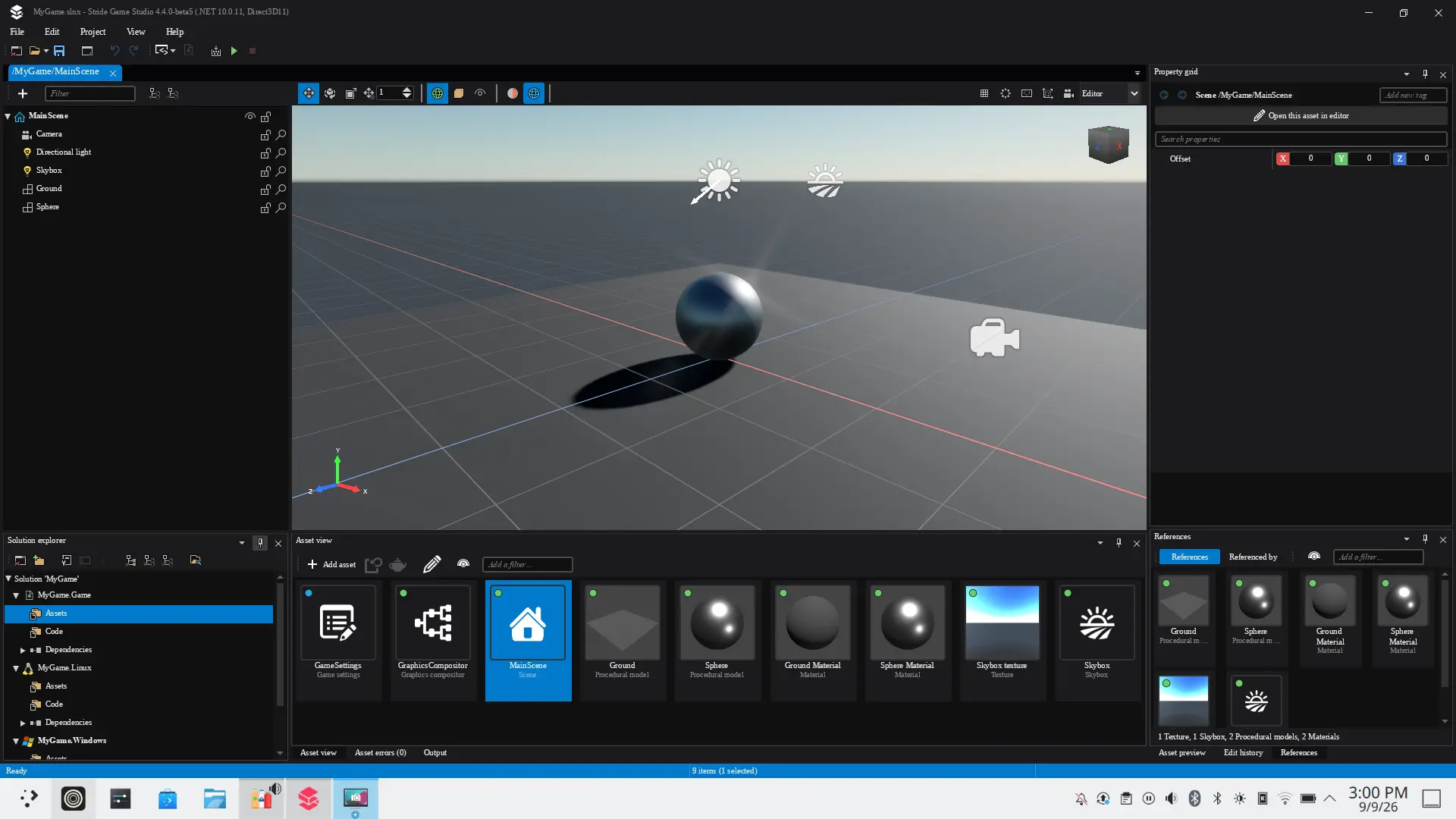
Note
Game Studio is being rewritten to be cross-platform.
Credits to Jklawreszuk for doing research and creating patches that enabled Proton support.
⌨️ New stride CLI tool
Some tasks that previously required the use of Game Studio or the launcher can now be done directly from the command-line! By using the CLI tool you can install and manage versions of Stride, create new projects and launch Game Studio with simple commands.
For more information, visit the Stride CLI page of our documentation.
dotnet tool install -g stride.cli      # Install Stride CLI
stride sdk install                     # Install the latest version of Stride
stride new topdownrpg && cd TopDownRPG # Create a project from a template
stride studio                          # Open it in Game Studio
dotnet new templates are also available if you'd rather use the standard .NET tooling directly:
dotnet new install Stride.Templates
dotnet new stride-game -n MyGame
🎮 Vulkan & Direct3D 12
Both APIs have received a large overhaul. They're now solid enough that we plan to make one of them the editor default and potentially remove Direct3D 11 in the next major release.
This overhaul also made it far easier to track down GPU crashes, as Stride can now pinpoint the exact rendering step that caused a device hang.
Note
If you write custom low-level rendering code, note that Direct3D 12 and Vulkan now use an explicit barrier/layout model. Direct3D 12 also requires Enhanced Barriers.
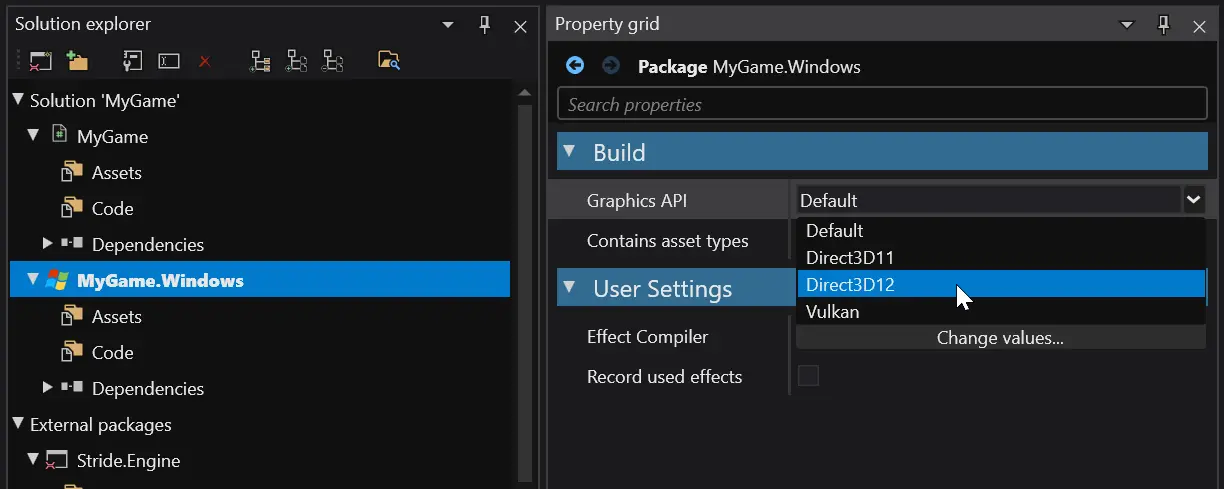
You can now pick the graphics API right from the UI for both your project and the editor. Game Studio can be configured in Settings > Environment > Graphics API (takes effect after a restart) and the game in the properties of the Windows package.
🎨 A brand-new SDSL shader compiler
The biggest internal change in 4.4 is a complete rewrite of the SDSL shader compiler, now built around a modern SPIRV-centric pipeline.
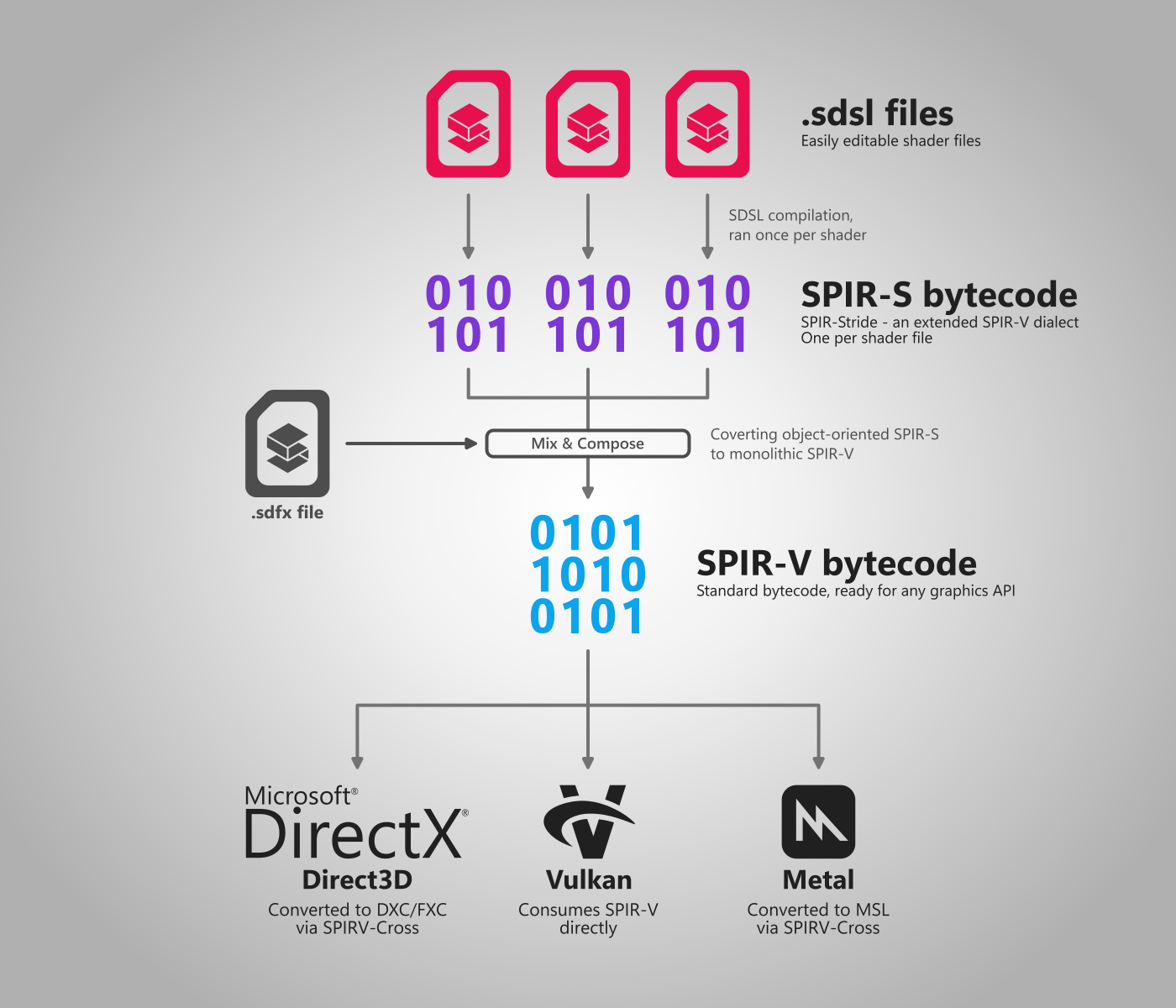
Instead of parsing and stitching shaders together as text, Stride now works in SPIR-V bytecode end to end:
- Each
.sdslshader is parsed once and compiled into its own SPIR-S module (SPIR-Stride, Stride's extended SPIR-V dialect). - Effects (
.sdfx) then mix and compose those modules directly as bytecode, converting the result to standard SPIR-V for the GPU backend. - Crucially, text parsing happens only at that first step: recombining a new shader variation from already-compiled SPIR-S needs no re-parsing.
What this means for you:
- Much faster shader handling. Generating the many shader permutations a game needs now works directly with byte-code, without a need to re-parse any text.
- Improved stability. Stride now uses battle-tested tools in order to handle conversion between different Graphics APIs.
- Far better support for advanced features. Direct3D 12 and Vulkan now handle things like tessellation and compute shaders much more reliably.
- A future-proof foundation. With a real SPIR-V pipeline in place, adding modern GPU features such as ray tracing, mesh shaders/meshlets and wave intrinsics becomes much easier going forward.
Warning
Because the entire shader compiler was replaced, custom .sdsl shaders may need minor adjustments to compile cleanly. If you encounter any problems, please open an issue on GitHub so we can fix it.
Huge thanks to Youness Kafia, whose early prototyping and experimentation laid the foundation for the new SDSL pipeline.
⚡ NativeAOT & trimming support
The engine is now NativeAOT and trimming-friendly. This unlocks smaller, faster-starting, self-contained game builds. For more information on how to use this, visit the documentation.
📦 Improved assets and content workflow
Stride 4.4 makes it easier to work with assets through code thanks to the automatically generated Assets class, which provides strongly typed URL constants for all assets in your project. Now when you rename an asset, you will get build errors instead of a "content not found" message during runtime.
// Old approach
var playerModel = Content.Load<Model>("Models/Player");

// New approach
var playerModel = Content.Load(Assets.Models.Player);
Asset paths from external packages now begin with a namespace, to ensure there are no conflicts between different libraries. This won't break your existing projects, as the paths will be automatically changed in your code during the upgrade.
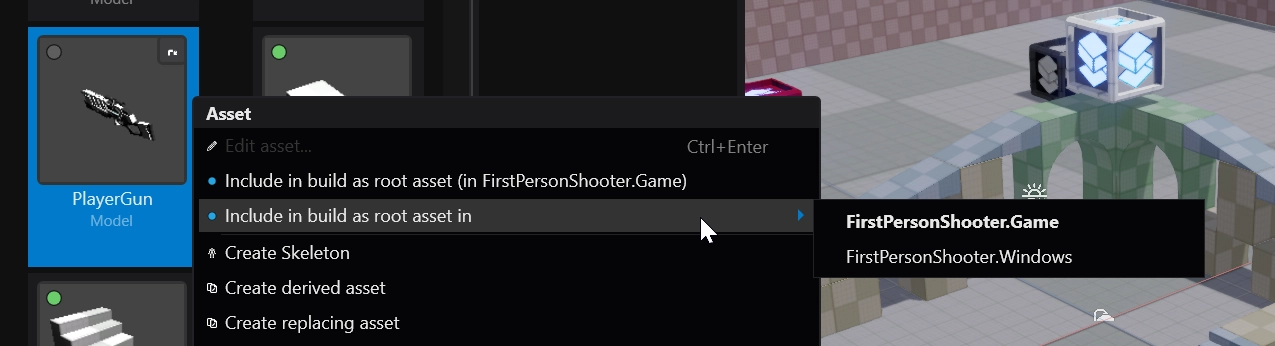
Adding assets to root now defaults to using the project package that an asset belongs to instead of the current one (like MyGame.Windows). This ensures that your assets work the same across different platforms. Game Studio also now tells you the name of the project package where the asset will be root and allows you to choose from alternatives.
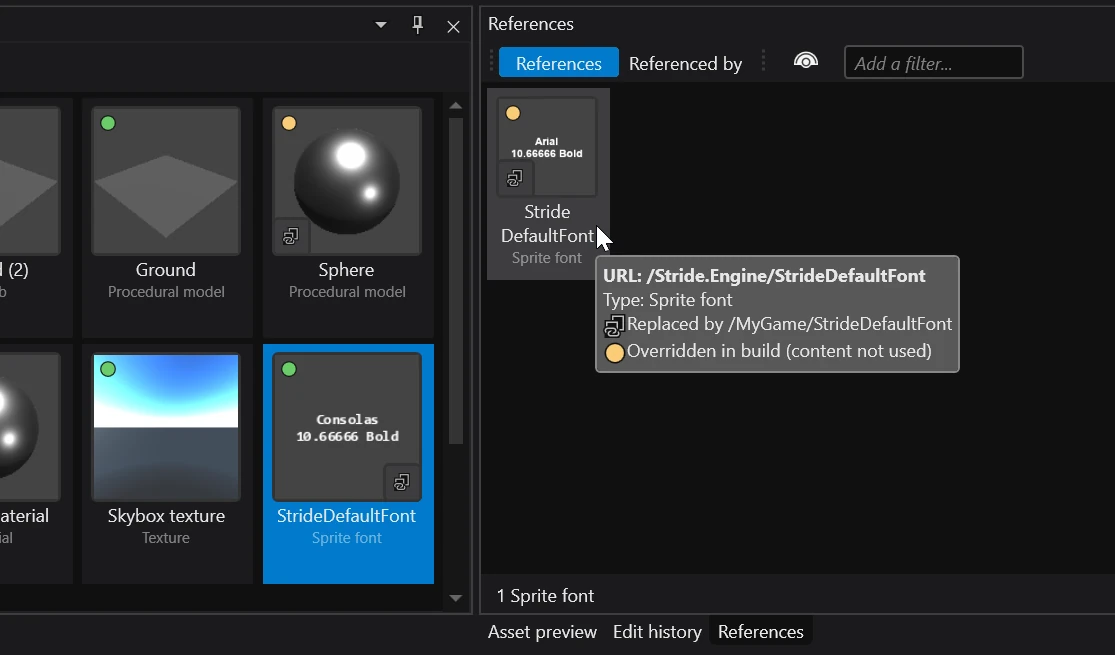
Finally, Stride now allows you to create replacement assets, which can be used to override assets from external packages or even the engine itself. For more information, visit their dedicated page in the documentation.
🚀 Launcher update
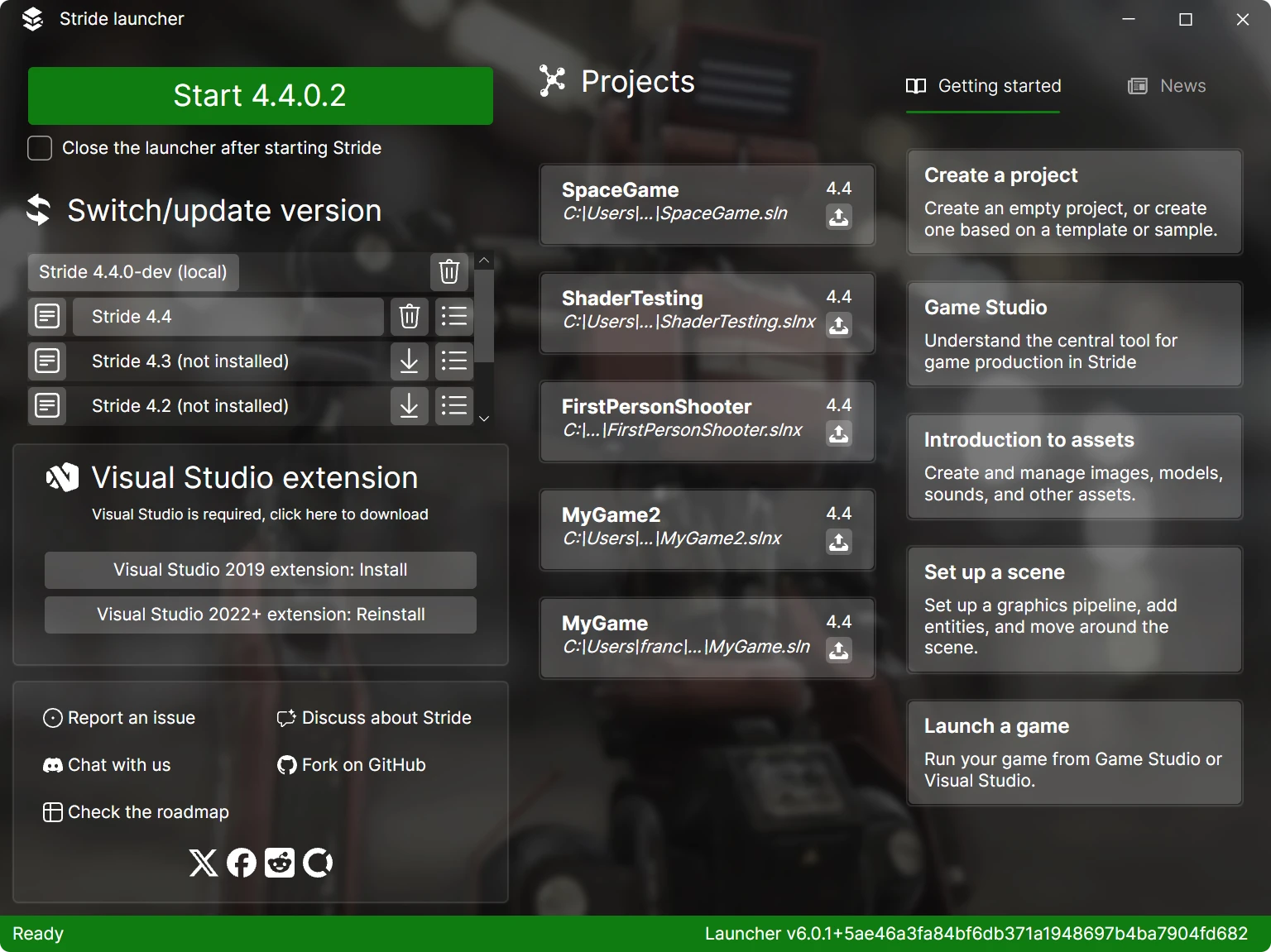
Along with 4.4, we also released an update to the launcher. On the surface, everything is mostly the same, aside from a minor face-lift. The real change comes under-the-hood with the launcher now using Avalonia as its UI framework, which will make it possible to target Linux and macOS in the future.
Note
The launcher's color scheme is synchronized with your system.
The new launcher is a part of the ongoing cross-platform editor rewrite. This is an enormous endeavour that will take a lot of time and effort, so if you are willing to help, check out the white paper and the Avalonia Editor Rewrite project on GitHub.
Credits to Kryptos for leading the avalonia rewrite and doing most of the work on the new launcher.
🧰 Building and engine architecture
- Much faster asset builds. Assets compile 2x faster for a typical game, and up to 10x faster for Stride's own tests, thanks to a new asset-build cache.
.slnxis the new default solution format. Existing.slnsolutions still open and save normally.- Game Studio can now open projects that use newer versions of .NET. You can use the newest C# features in your projects without having to update or fork the engine.
- Support for file-based apps. You can now create a Stride game using a single C# file. For more information, check out the community toolkit.
- Dropped support for 32-bit. The engine now only targets modern 64-bit systems.
⚙️ Changes to the physics CharacterComponent
While our integration of the Bepu physics engine is definitely mature enough by now, the CharacterComponent we introduced was not as well put together as it ought to have been.
- The gravity you may set would be mutated internally to prevent the body from sliding down slopes.
- Moving surfaces would not carry the character along with them.
- Moving past a slope would cause the character to fly off.
- Forces applied to bodies, and especially constraints, required unintuitive tweaks to work.
We looked at Bepu's own character example to solve these issues. Unfortunately, we could not avoid introducing a fair amount of breaking changes. Fortunately, we added a couple of sections in Characters to describe the new features and properties.
📖 Documentation
Since 4.3, our documentation has received a lot of changes. This is a part of an ongoing effort to bring the documentation up-to-date and restructure it to provide space for future content.
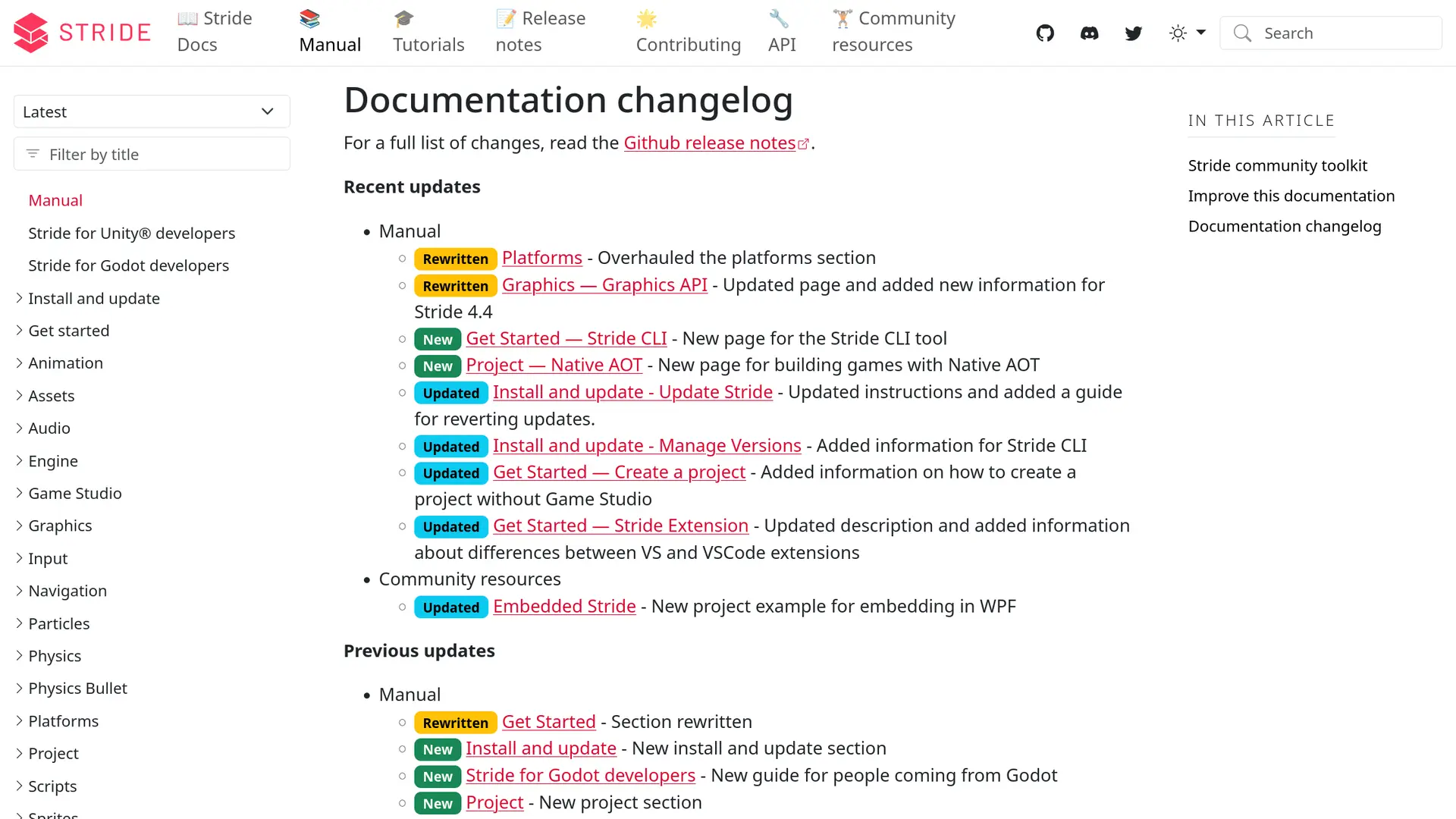
- Get started and Platforms have been rewritten from scratch.
- New sections: Assets, Install and update and Project.
- New pages for new features: NativeAOT, Replacement assets and Stride CLI.
- Brand new guide on how to build and publish games (link).
- Updated instructions on publishing custom external packages (link).
- Removed outdated sections and pages.
We have also started documenting parts of Stride's internal architecture in the main engine repository to help other contributors navigate this large codebase. A copy of these pages is available on the documentation website.
📈 Metrics and crash reports
Game Studio is now telemetry-free! We removed legacy metrics code, as it was mostly broken and the data collected with it didn't see much use. However, we are looking into reintroducing it in a future update as an opt-in system.
The crash reporter has been overhauled from the ground-up. It now runs independently from Game Studio and the launcher, which should make it much more stable compared to the old version.
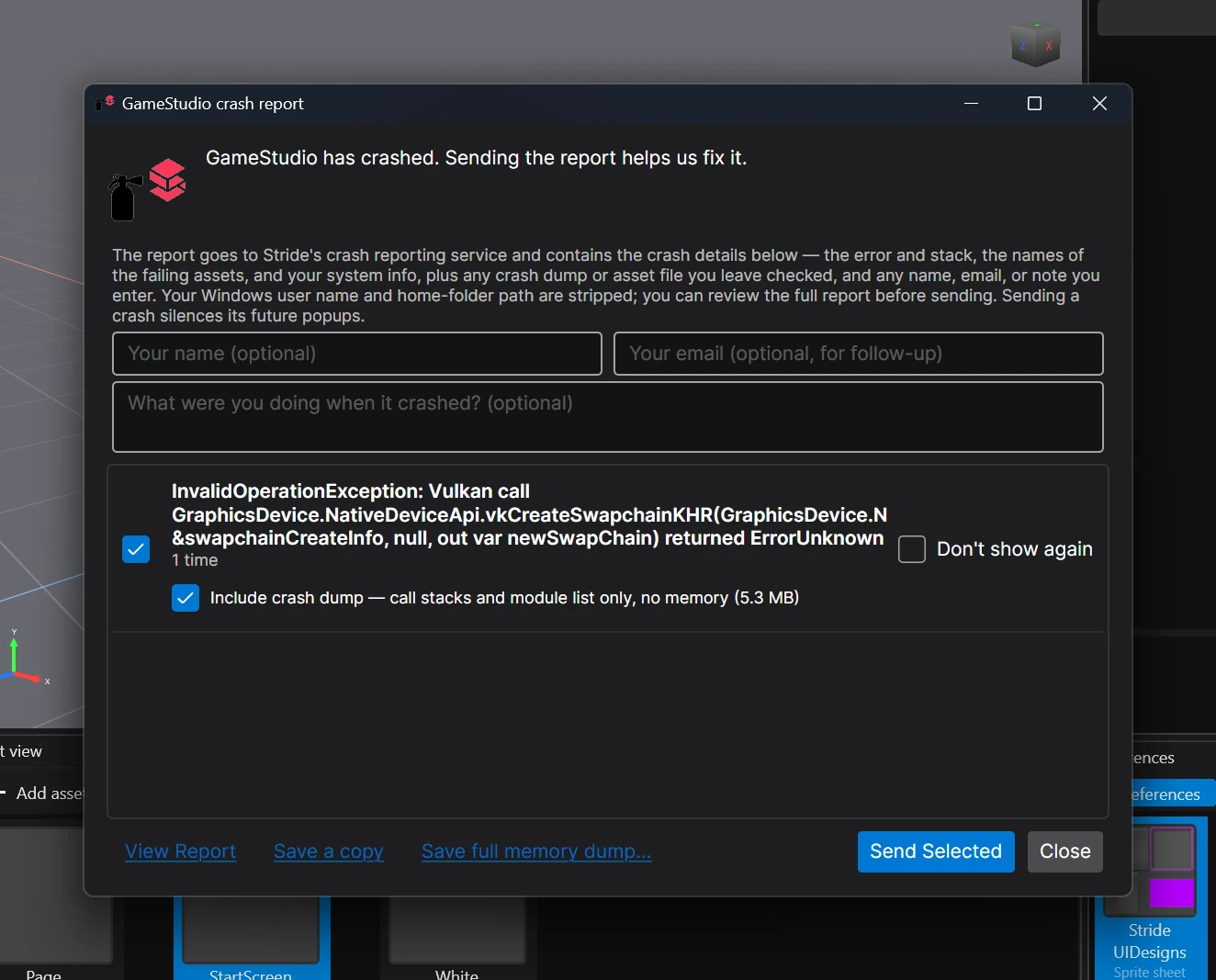
Crash reports can now be sent with a single button via Sentry. This should make it easier for us to fix common errors and improve engine stability. For full transparency, here are some notes about how crash data is collected and reported:
- You are in control. You can customize and view crash reports before they are sent.
- No automatic telemetry. Crash reports cannot be sent automatically without your consent. Note that failed uploads will be kept and sent later.
- All reports are private. Only certain core-contributors have access to the Sentry dashboard, which is the only place where crash reports can be viewed.
- Anonymity. The crash reporter masks user names, device timezone and other information that could be used to retrace your data back to you.
🧪 Quality & CI
These changes don't affect the engine directly, but they impact how confidently you can contribute back to its code.
Stride 4.4's test suite has been greatly expanded. Instead of being occasionally invoked for a few specific configurations, the CI (Continuous Integration) now runs the entire test matrix across all platforms and graphics APIs.
Regressions on any platform or backend are now caught automatically before any change gets merged. This means that you can confidently open a pull request and trust the CI to prove it works everywhere.
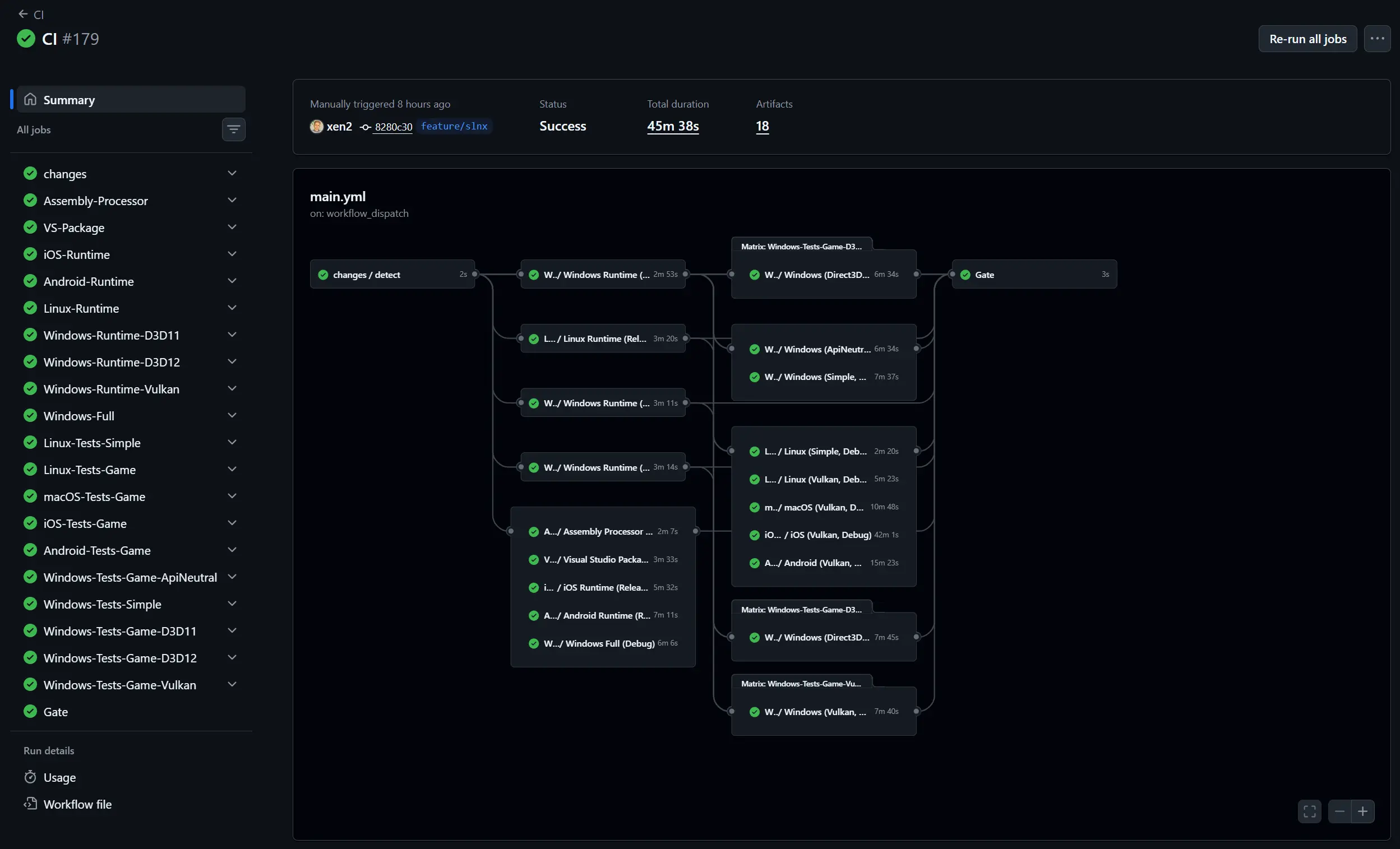
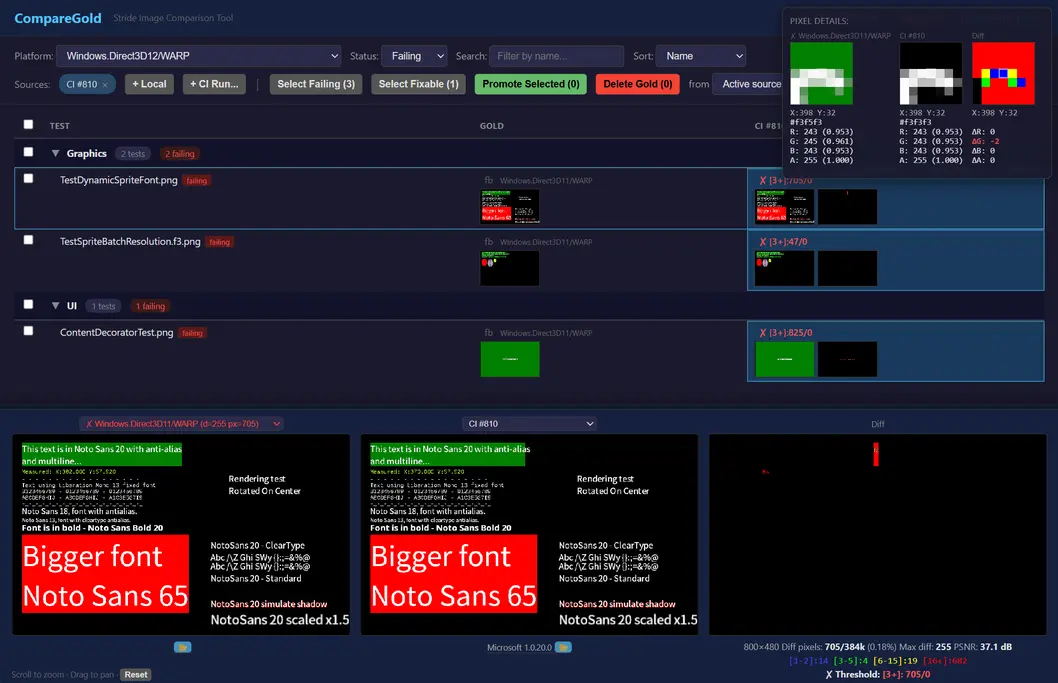
Our gold-image workflow has also received many improvements. For those unaware, Stride uses pre-taken screenshots (gold images) and compares them to new ones in order to test if its rendering capabilities work as intended. Of course, there are always small couple-pixel differences, even when comparing the same version, which is why it's important to have proper tooling.
The new CompareGold tool helps visualize differences between images and determine if something is wrong. It also makes it easier to promote images (replacing old gold images with new screenshots) and even pull results directly from any CI run or fork. For more information, check out GPU Regression Testing in the engine repository.
The CI can also now automatically generate gold images for every platform. This means that you no longer have to waste time retaking screenshots by hand, as the Test Gold Generation workflow will do it for you.
Breaking changes
- Custom shaders: the SDSL compiler was rewritten, so you might want to review how your custom shaders render. If you have a shader that no longer compiles or behaves differently, please open an issue on GitHub so we can fix it.
- Low-level graphics: Direct3D 12 now requires Enhanced Barriers. The legacy barrier path has been removed.
- Vulkan updated to 1.3: this might break support for older devices and users with outdated drivers.
- OpenGL has been removed: consider changing the graphics API of your project to Vulkan or Direct 3D.
- Convex hull changes: the library we use to generate convex hulls (V-HACD) was updated. This new version improves on speed and accuracy, but has a wildly different set of configurable parameters, so you may want to validate them for accuracy.
- Bepu
CharacterControllerwas reworked: existing character setups will behave differently and need adjustment. See ⚙️ Changes to the physicsCharacterComponent. - Removed the ability to override Game Settings: the feature was partially broken and not really that useful, which is why it was decided to remove it altogether. If you want to change settings depending on a user's platform/device, consider creating a custom Game class.
- Dropped support for 32-bit systems.
Changes to code API (should be automatically resolved during project upgrade):
GameSettings.Configuration.Get<T>is nowGameSettings.GetOrCreateConfiguration<T>Utilities.CopyWithAlignmentFallbackis nowMemoryUtilities.CopyWithAlignmentFallback.Utilities.Clearis nowMemoryUtilities.Clear.Utilities.AllocateMemoryis nowMemoryUtilities.Allocate.Utilities.AllocateClearedMemoryis nowMemoryUtilities.AllocateCleared.Utilities.FreeMemoryis nowMemoryUtilities.Free.Utilities.IsMemoryAlignedis nowMemoryUtilities.IsAligned.Utilities.Swap<T>is nowMemoryUtilities.Swap<T>.ScrollViewer.ScrollOfInternalis now private.
Acknowledgements
We'd like to thank everyone who contributed to 4.4:
- Acissathar
- azeno
- Basewq
- D4rkDuck
- Doprez
- ds5678
- Eideren
- Ethereal77
- Feralnex
- Henr1k80
- JeroMiya
- Jklawreszuk
- johang88
- kjnorris1205
- Kryptos-FR
- laske185
- luca-domenichini
- MsEpsilon
- Nicogo1705
- rafzi
- Redwarx008
- sasvdw
- Spajker7
- steveberdy
- VaclavElias
- w0wca7a
- xen2
- ykafia
We'd also like to welcome new contributors who created their first PRs in this release:
- JeroMiya made their first contribution in https://github.com/stride3d/stride/pull/3022
- D4rkDuck made their first contribution in https://github.com/stride3d/stride/pull/3011
- ds5678 made their first contribution in https://github.com/stride3d/stride/pull/3075
- rafzi made their first contribution in https://github.com/stride3d/stride/pull/3087
- MsEpsilon made their first contribution in https://github.com/stride3d/stride/pull/3098
- Redwarx008 made their first contribution in https://github.com/stride3d/stride/pull/3093
- kjnorris1205 made their first contribution in https://github.com/stride3d/stride/pull/3118
- luca-domenichini made their first contribution in https://github.com/stride3d/stride/pull/3089
- steveberdy made their first contribution in https://github.com/stride3d/stride/pull/3079
- Henr1k80 made their first contribution in https://github.com/stride3d/stride/pull/3156
And finally, we'd like to thank the rest of the Stride community for donating, testing builds, providing feedback and helping us shape this update. ❤️